
Photo by Prince Kwembe on Unsplash
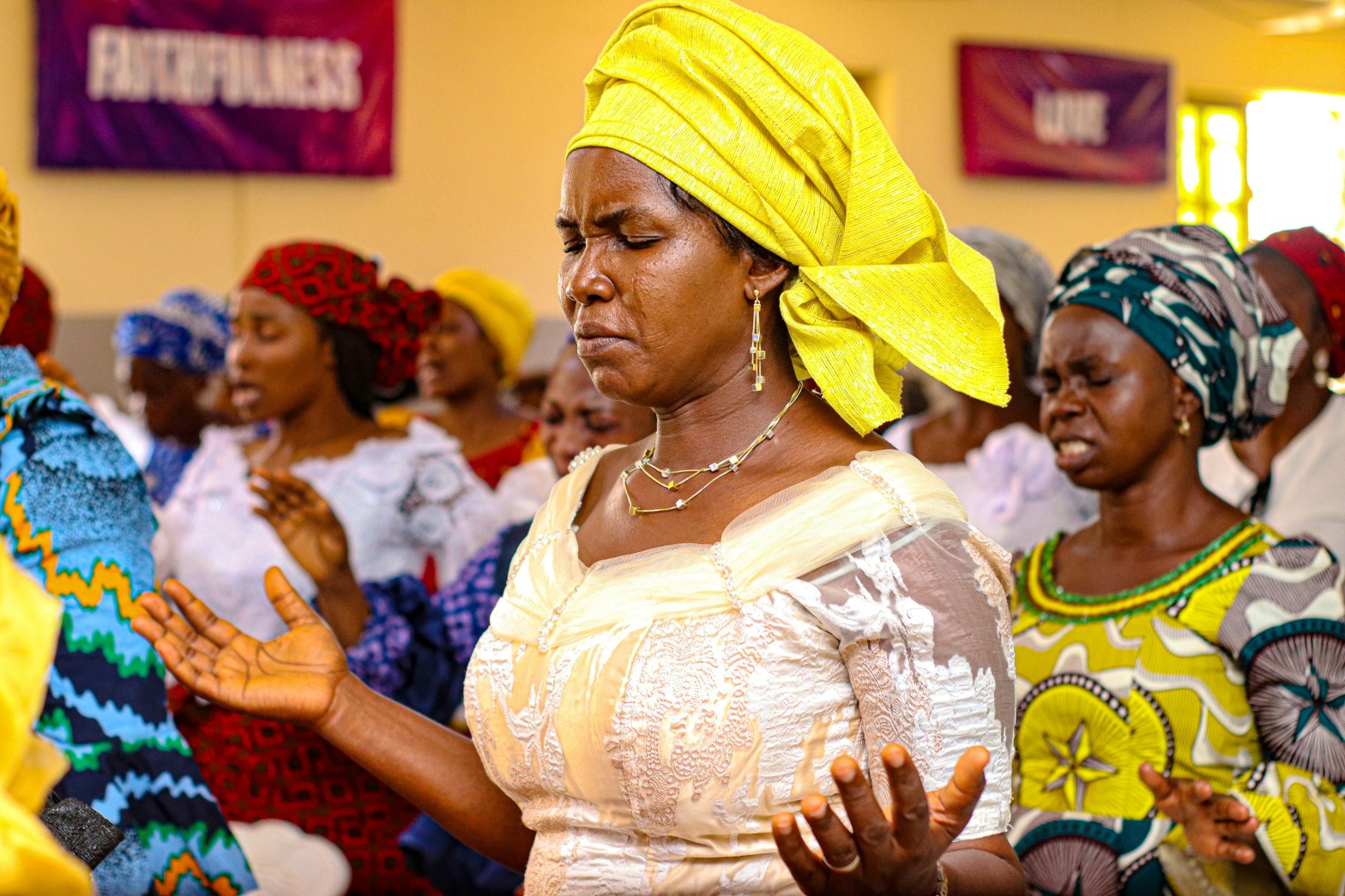
In 2005, missiologist Stephen Bevans observed that the average Christian in the world was female, and likely to be found in an African village or a Brazilian favela.1 A shorthand description of the same reality is that World Christianity is “young, black and female”. So, what’s behind that moniker and why does it matter?
Bevans was describing the seismic shift of the twentieth century: 100 years ago, 18% of Christians lived in the majority world (Asia, Africa, Latin America, Oceania) but today 67% of the world’s Christians are in the majority world and that number is expected to be 77% by 2050. Meanwhile, many Christians in Europe (for example) are not necessarily white. One in six church attenders in the UK are non-white. The Redeemed Christian Church of God in the UK, which has a Nigerian senior pastor and largely black attendance, has over 870 parishes. That’s still not as many as the 2000 Baptist churches in the UK or the 16,000 Church of England buildings, but the RCCG regularly gets over 40,000 people to their overnight prayer vigils!
The ‘black’ part of ‘young, black and female’ recognizes two things: first, that the majority of the world’s Christians are in the majority world, and second, that committed Christians in the West are increasingly migrants or people of colour as well. ‘Black’ as a descriptor of the majority world church is inadequate of course. It does not account for the 2000 ‘Canaan Hymns’ written by Chinese Christian Lü Xiaomin and widely used in both the underground Protestant church and the Three-Self Patriotic Church, or the prediction that in Guatemala and Honduras, evangelicals will outnumber Roman Catholics by 2030. Yet, its currency is in how it causes us to pause and give attention to the make-up of World Christianity; to explore its range and breadth and variance; to sit with the reality that many Christians in the world do not look, think, act or theologise like us.
In particular, the ‘black’ moniker highlights Africa. At the Edinburgh missions conference of 1910, none of the 1215 delegates were African, and a decision was made to focus on Asia, which was deemed a more promising mission field than Africa, because Asia was both more populous and regarded as more sophisticated. Yet, it has been Africa where the gospel has borne dramatic fruit, however unlikely that seemed then, to the glory of God alone.
Understanding this make-up and momentum of World Christianity clarifies the ‘young’ part of the moniker as well.2 In Africa 40% of the population is under the age of 15 and 70% under the age of 30. (In part this is because of extraordinary improvements in infant and child health.) In Latin America, the same figure is 25%. Meanwhile, in Australia and Europe, it dwindles into the teens. You see more grey heads in Australian and European churches in part because that’s who is in society. In Africa, only 3% of the population are over 65, so you would expect to see fewer in church too. We can praise God for an almighty work among young people in Africa, but that is not necessarily to the exclusion of older people: it’s just who is there.
The ‘female’ part of the moniker, on the other hand, does not reflect population. Around the world, male-female populations are fairly even. However, the church is not as even as populations: women outnumber men disproportionate to population, often by a spectacular margin, like in Burkina Faso where women are 90% of church members, or the Presbyterian Church in Korea which is 70% female. (In fact, the only country in the world where Christian men outnumber Christian women is Qatar, because men outnumber women so greatly in the general population due to the oil industry.) This predominance of women in World Christianity is not reflected in leadership: around the world, churches are largely (though not exclusively) led by men. Nevertheless, missiologist Dana Robert called World Christianity a women’s movement, because it is women who do the lion’s share of pastoral care, discipleship, children’s ministry, Bible study, teaching, evangelism, ministries of care, peacebuilding, administration, social justice, and so on.3
Having understood a little more of where ‘young, black and female’ comes from, it’s worth reflecting for a moment on what effect this knowledge might have on us, especially if we are not ‘young, black and female’. I am female, but as I push my way into middle age and burn up like a crisp the moment the sun hits my skin, I am not the ‘young, black and female’ average of World Christianity. That might make me feel a bit ‘other’ in World Christianity, or a bit insecure, like there’s not a place for me.
If I feel this way, I might remember that in the Bible, it was often the majority of God’s people who were being unfaithful, and that he was working through his prophets at the margins or with a small but faithful remnant. Similarly, for a long time there has been a concern that the church in Africa is ‘a mile wide but only an inch deep’, that is, multiplying in numbers but not in maturity. So, it might be easy for me to point to my own maturity or theological depth as an antidote or a help, to establish my position in World Christianity.
However, at that point, I would still largely be speaking out of my ignorance, for what evidence do I have that the church is Africa is indeed only an inch deep? Might it be possible that the Holy Spirit can and is growing both breadth and depth at the same time? And how should I think of my own maturity and theological depth when my formation has not benefited from this burgeoning of the church, and my faith has not been tested in the swamp of poverty?
Understanding that the church is ‘young, black and female’ might relegate my role in World Christianity to one of learner or co-worker rather than teacher or arbiter of truth. That might be humbling for me, but it can also be very exciting. God is at work and his workforce is so much bigger than me! If World Christianity is a body of water, it is no longer just my little trickle, but a whole rushing stream that I can join.
If you want to learn more about the rushing stream of World Christianity, I recommend:
- Young Langham’s ‘Out of the Margins’ podcast
- The substack of Malawian missiologist, now living in the UK, Harvey Kwiyani
- Gina Zurlo’s book ‘Women in World Christianity’ (or the numerous summary lectures available on YouTube.)
Dr Tamie Davis is a Mentor with the Angelina Noble Centre and Mobilisation Lead for CMS SANT. She served in Tanzania with CMS for 10 years and completed a PhD about the prosperity theology of a group of Tanzanian women.
- Stephen Bevans and Roger Schroeder, ‘Missiology after Bosch: reverencing a classic by moving beyond,’ International Bulletin of Missionary Research 29, no.2 (2005): 70. ↩︎
- The statistics in this paragraph come from Gina Zurlo’s book Women In World Christianity, which contains excellent demographic analysis of World Christianity. ↩︎
- Dana Robert, ‘World Christianity as a Women’s Movement,’ International Bulletin of Missionary Research 30, no. 4 (October 2006): 180. ↩︎
 thewadrproject.com