
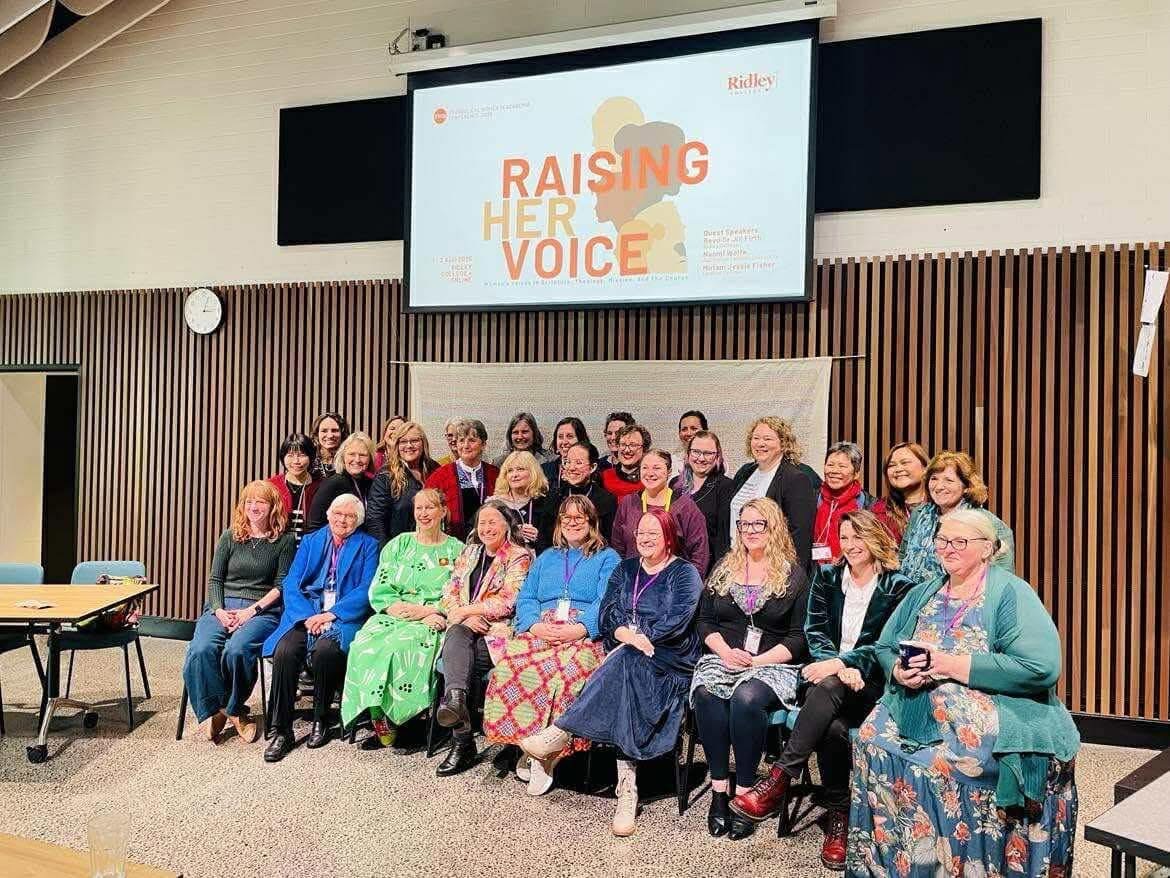
Photo of conference contributors by Jane Baulis, used with permission.
This year’s “Evangelical Women in Academia” (EWA) conference, run by Ridley College, revealed the rising strength and lasting impact of this conference initiative. Its genesis was ten years ago when the late Dr Moyra Dale kicked off a piece of collaborative research into women’s participation rates in higher degree research in the Australian theological space. The research was published in 2018. One of those original collaborators, Rev Dr Jill Firth,1 conceived in response an academic conference for evangelical women which would give them a platform, opportunities, experience and encouragement. This year, organised by Rev Dr Hannah Craven with the theme “Raising Her Voice,“ the conference drew nearly 100 women in person on each of the two days, drawn from around Australia, New Zealand and one woman from the Philippines, plus many more online. There were a range of denominations represented, with Anglican and Baptist women in the majority.
That original research is in the middle of a process of updating by a team of five academics, Dr Louise Gosbell, Dr Diane Hockridge, Dr Erin Hutton, Kara Martin and Rev Dr Megan Powell du Toit. The current progress was presented in a plenary session to show the progress over the past ten years. It included a roll call of the women awarded a doctorate through the Australian University of Theology over the decade. The number of those women who were present at the conference is a testament to the significance of EWA for today’s church and academy. The roles of the Angelina Noble Centre and Anglican Deaconess Ministries in supporting these spaces were noted and celebrated.
Each day was emceed with warmth, humour and sensitivity by the wonderful Flyck Clift, also on staff at Ridley. The morning keynotes were given by Rev Dr Jill Firth, drawing on her research into the women mentioned and referenced in the book of Jeremiah, and identifying differences between historical women and metaphorical women such as “Daughter Jerusalem.” Academic papers were delivered in streams including Old and New Testament, Practical Theology, Culture, Marginalised Voices, Responses to Trauma, Church History, and Women’s Leadership.
I chose an alternative to the Women’s Leadership stream, but the buzz and energy as the women in that session came out into the courtyard was palpable, as they extolled the calibre of those papers given by Dr Laura Rademaker and Erica Mandi Manga. I had instead attended the Trauma stream, where Rev Amy Brown’s paper on lament as a resource in processing trauma was incredibly helpful and insightful and Rev Dr Hannah Craven’s methodology of interacting with diverse schools of thought in order to learn and be provoked rather than just to critique, had many great insights.
The theme of listening across difference permeated the conference, as the tone of camaraderie provided a safe space for acknowledging diverse views. There were women holding both complementarian and egalitarian theology, and others still exploring where they land on those questions. There were differences in ecclesiology, pneumatology, methods of enculturating the gospel, and diverse ideas for what practical responses may best serve the endeavour of increasing women’s participation and opportunities in academia and the church. It was refreshing to be able to explore such deep and heartfelt questions in a safe and respectful context as we learnt and reflected together.
While EWA is an academic conference, it recognises the significance of theological application to the whole person and the power of creative response. The Friday night conference dinner included a keynote by Miriam Jessie Fisher from Laidlaw College in New Zealand. She has produced a hand-stitched banner that contains every word of direct speech spoken in the Bible by a woman. The banner was on display, as she shared with us poetry she is writing in the voice of biblical women, exploring their stories in heartfelt and powerful ways. We were then challenged in our table groups to create our own short poem to represent another biblical woman. The creative power within the room was unleashed with poetry, not just created but shared, enacted, and delivered with power and passion, all in the space of the evening. One group even delivered their poem in biblical Hebrew! The opportunities for practical exploration and response continued with a series of workshop options on the Saturday afternoon, while the online cohort participated in a seminar led by Dr Kamina Wust on Women’s Voices in the Song of Songs.
Surveying the milling crowd during break times, it is apparent that the camaraderie at EWA is one of its very special ingredients. Friends old and new connect, share, encourage, and collaborate. The fellowship itself is rated by many as a key highlight of this event, and a drawcard worth the investment to physically come from as far away as Darwin, Brisbane, Auckland, and Manila.
On the Saturday afternoon I had the pleasure of hosting a panel exploring Women’s Leadership and the Stained Glass Ceiling, hearing perspectives from Rev Dr Melinda Cousins (Director of Ministries for the Baptist Union SA/NT), Rev Tracy Lauersen (People and Culture Commission of the Anglican Church of Australia) and Dr Jacqueline Service (Director of St Mark’s Theological College). Each shared vulnerably about the challenges, yet also with encouragement about progress. They gave us practical wisdom for continued growth in genuine opportunities for women seeking to use their God-given gifts in leadership, ministry, and academia. That session concluded with a time of prayer for breakthrough and resilience.
The conference closed with a keynote from Naomi Wolfe, a trawloolway woman who is a Lecturer at Australian Catholic University. Titled “let anyone with ears to hear listen!”, she called on us to hear the voices, stories and experiences of Indigenous sisters and their perspectives and journeys. I also took the opportunity to buy a copy of Dr Tamie Davis’ newly-released book Mafanikio Theology, published by Langham, and based on her doctoral research into the theology of Tanzanian women.
As a woman who works with focused intentionality to hold space for both myself and for others seeking progress in ministry skills, theological education and ordination pathways, I deeply value my involvement in EWA and have been to all six that have been held so far. The 2027 EWA will mark ten years of this conference. How many more women will have higher degree research commenced or completed, paid ministries embarked upon, and leadership positions fulfilled, in part through the encouragement, contacts and support of this event? Only time will tell, but I would argue this conference is one of the most strategic gifts to the church from Ridley College, and one that is worthy of great celebration and affirmation.
Disclosure: the author Suzie Ray is a graduate of Ridley College and facilitated a plenary session of the conference.
Rev Suzie Ray is Rector of St James Anglican Church in Darwin.
- The other researchers alongside Jill and Moyra were Kara Martin and Megan Powell du Toit, who are also on the new research team. ↩︎
 thewadrproject.com