
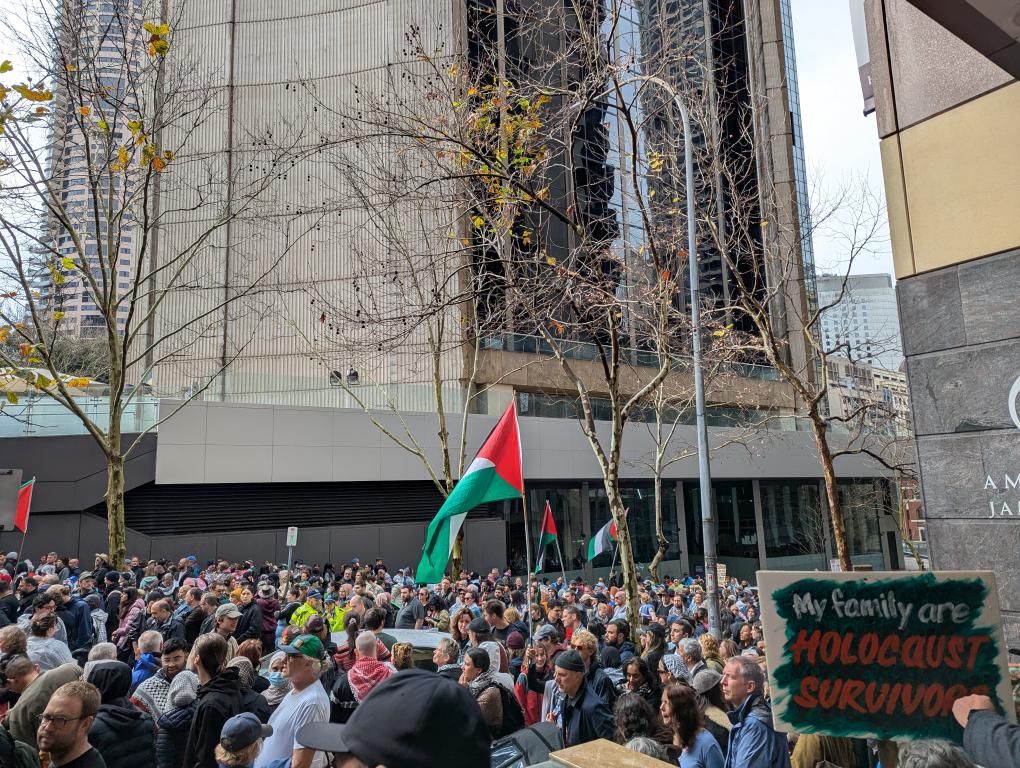
Photo by Aimee, from Wikimedia Commons, CC BY-SA 4.0.
On Sunday August 3, I took part in the March for Humanity, walking across the Sydney Harbour Bridge in a protest with thousands of others. The March was organised by the Palestine Action Group. The official estimate of how many were in the protest was 90,000 people, but others suggest it may have been anywhere between 200,000 to 300,000 people. Here, in response to a request from the WADR team, are a few of the reasons I participated.
I understand that not everyone who took part in the march did so for reasons that were identical with my own. I understand, too, that many people who share my theological and ethical convictions and my view on the situation in Gaza may have come to different conclusions about whether to participate in the march. But these were my reasons.
1. I marched because of the command and example of Jesus.
Jesus commands us to love our neighbours as we love ourselves. He teaches us to live in obedience to the moral vision taught in the Old Testament Scriptures, which tell us from the very first pages of Genesis that human beings are created in the image of God and therefore, by implication, precious in his sight. He shows us what love looks like by laying down his life for our salvation.
2. I marched because of the magnitude of the sufferings that so many have already endured as part of the Israeli-Palestinian conflict.
The history of the Israeli-Palestinian conflict is a long and bloody one. The trail of suffering that it has inflicted stretches far back beyond the nightmare of the last two years to the violence and misery of the 1948 war, the massacres and atrocities that preceded and accompanied it, and the expulsion of hundreds of thousands of Palestinian refugees into an exile from which they have still not returned. And it stretches further back still, to include the long, dark history of antisemitic discrimination and violence that contributed to the impetus of the Zionist movement and accelerated the wave of Israeli settlers in the aftermath of the holocaust and the Second World War.
More recently, it has included the recurring Israel-Gaza conflicts in the years following the seizure of power by Hamas in 2007. And it has escalated alarmingly in the thousands of Israeli lives that were lost in the carnage of October 7, 2023, the hundreds of hostages who were taken as part of that incursion, and the tens of thousands of Palestinian lives that have been lost so far in the Israeli reprisals that followed.1
It has been a long and miserable history, and like countless others all around the world, I long to see that history of suffering come to an end. Because that is the case, I urgently desire to see an end to the current course of events, which are serving only to entrench, extend and exacerbate those sufferings.
3. I marched because of the potential for the present crisis in Gaza to spiral into an even worse humanitarian catastrophe.
What we have seen already in the events of the last two years is horrific enough. But as more than one hundred international aid organisations and human rights groups have made clear, unless there is an immediate and massive increase to the volume of aid and safe, internationally supervised arrangements for its distribution this could be just the beginning of something unthinkably worse.
4. I marched because I am convinced that there is more our government could do to exert influence toward a just and peaceful resolution of the current conflict.
In recent months our government has made a series of statements, joining with others around the world to express increasingly urgent concerns about the conduct of the war in Gaza and its humanitarian consequences. But something more than statements of this sort is needed, in keeping with our duties under international law.
Under the current circumstances, I do not see how our government can in good conscience continue to provide export licences for Australian-manufactured components that enable the deadly work of the Israeli strike fighters. Nor, under the circumstances, do I think our government should permit continuing Australian involvement in the larger, two-way arms trade (and military research and development cooperation) with Israel.
The targeted sanctions imposed earlier this year on Itamar Ben-Gvir and Bezalel Smotrich, based on their role in inciting settler violence and the forced displacement of Palestinians in the West Bank, were a small, belated, step in the right direction. But the ongoing support of the entire Israeli government for the illegal West Bank settlements and their direct involvement in the violence associated with them, together with the scale and nature of their military actions in Gaza, in defiance of the International Criminal Court and the International Court of Justice, should surely call for much heavier and less narrowly targeted sanctions than these.
5. I marched because I support the aims of the protest
Because of all the considerations above, it should probably come as no surprise that I am in agreement with the stated aims of the March for Humanity’s organisers: an end to the restrictions that have been imposed by the IDF on the admission of humanitarian aid into Gaza; an immediate ceasefire and withdrawal of Israel forces from Gaza; the imposition of a broader set of Australian sanctions on the Israeli government; and an end to Australia’s two way arms trade with Israel.
I want to see much more than these things, of course. I want to see the release of all the remaining hostages being held by Hamas, along with the Palestinian people being held without trial by the Israeli authorities under administrative detention. I want to see Hamas disarm and relinquish power in Gaza, and a new governing authority installed through free and fair elections. I want to see protections in place to ensure the safety and liberties of ethnic and religious minorities. And somehow, as an outcome of it all, I want to see a just and sustainable long-term resolution to the whole Israeli-Palestinian conflict.
Some of these things are steps toward others, some are preconditions that must be satisfied before others can take place, and some are matters that must be dealt with simultaneously as part of a negotiated resolution. All of that I understand, but it does not overturn the fact that I am convinced by, and in agreement with, the protest’s core aims.
6. I marched because I was confident in the measures the organisers had taken to prevent causing harm or inciting hatred
The instructions given by the organisers of the march were clear. This was an urgent, passionate protest, which aimed to send a loud, clear message. But there was to be no tolerance of “any form of racism or bigotry, including antisemitism or Islamophobia”; there were to be no “flags or symbols which could be considered in breach of Australian legislation”; there was to be full cooperation with the police and NSW Transport to ensure “a safe, family-friendly event for everyone.”
It is in the nature of a large-scale peaceful protest, as Justice Rigg correctly emphasised in her ruling on Saturday, to cause some measure of disruption to the general community. In an event on the scale of last Sunday’s march it is impossible to foresee every possible contingency or, for that matter, to exercise total control over the pictures on every poster or the wording of every banner. But the organisers made their own position clear; they continued to liaise closely with the police and transport authorities throughout the duration of the march; and the crowd, which massively exceeded all predictions, was extraordinarily gracious and patient as the rain kept pouring down and the directions for how to disperse kept changing.
7. I marched because God is a compassionate, just, and powerful God
God cares about the plight of all the people whose lives are affected by the current events in Gaza. He invites us to pray and, insofar as we have opportunity to do so, to act in love for the good of those who are suffering. And he encourages us to trust that as we call on him in prayer and act in faith, he will “fulfill every resolve for good and every work of faith by his power, so that the name of our Lord Jesus may be glorified.” So, I want to resist the temptations to apathy and despair, to take the opportunities that God gives me to act and to pray, and to trust the outcome to him.
Rev Dr David Starling is Vice Principal (Academic) and Lecturer in New Testament at Morling College.
- See numbers reported by the United Nations Office for the Coordination of Humanitarian Affairs. ↩︎
 thewadrproject.com