
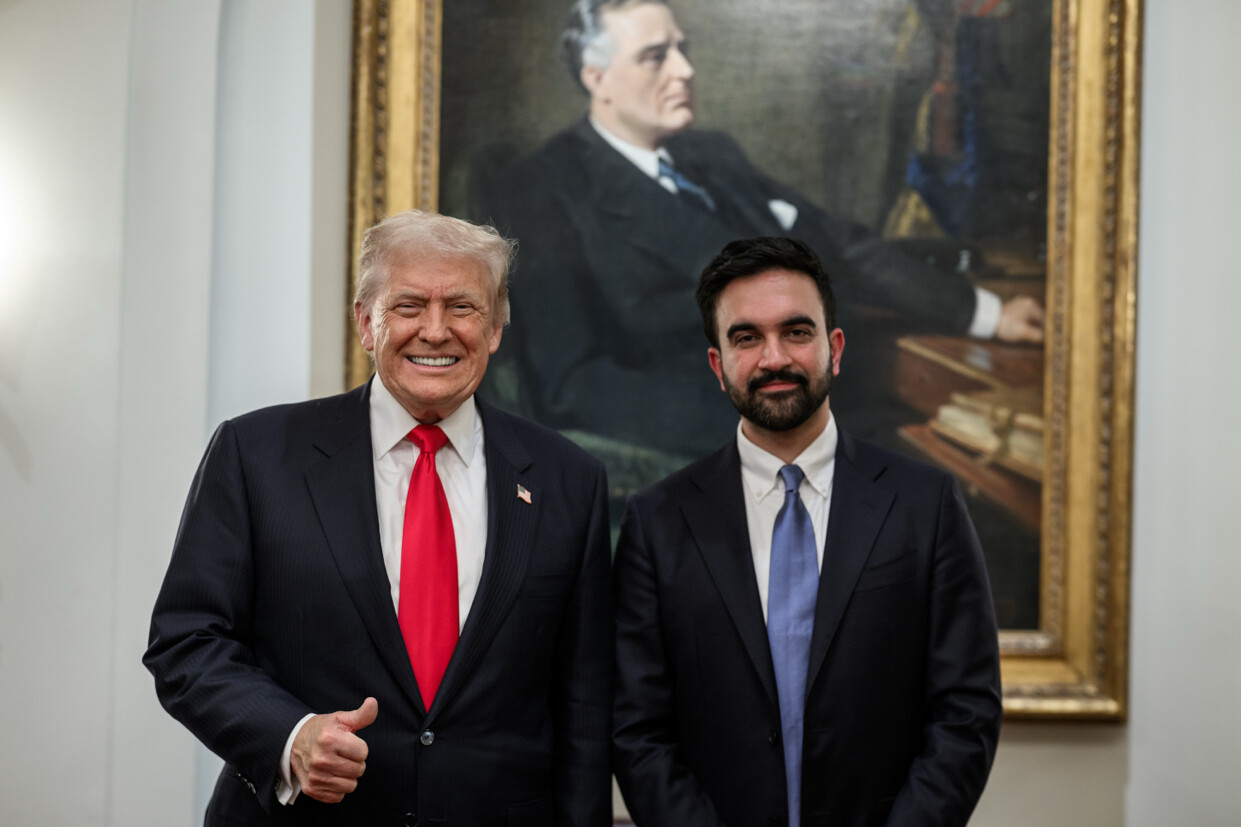
Picture: NYC mayor-elect Zohran Mamdani (right) and President Donald Trump meeting at the White House. Public domain.
On January 1st of this year, Democrat Zohran Mamdani was sworn in as the mayor of New York City. He was elected on 4th November 2025, after a year-long campaign built on unapologetically Socialist priorities aimed at ameliorating the average American’s suffering in an affordability crisis. US President Donald Trump, himself a born-and-bred New Yorker, threatened to withhold federal funding from the city because of Mamdani’s election, which he claimed signals a “communist” future for the Democrats.
Mamdani’s response? “It is time to finally stand up to the bullies that make these threats, not to become the bullies ourselves.” Them’s fighting words in the world of personality politics, where many shots have already been fired over Mamdani’s Indian descent, immigrant status, and Islamic faith.
Fast forward to November 21st. Mamdani requests an audience with Trump at the White House. Trump heralds his agreement to the meeting on his socials, again calling Mamdani a communist. While these types of meetings are customary for mayoral appointments, one can’t help but feel the spectre of a Hamiltonesque duel looming… and neither combatant seems keen to throw away their shot.
Yet, the day arrives, and the two men are snapped smiling at each other.
No sound nor scent of gunshot. Mamdani, unassuming in a muted blue tie, hands loosely clasped, clapped gently on the forearm by a fellow New Yorker in Republican red. Whether contrived or truly candid, the eyeline, posture, and status show an unexpected affability between the two political households.
More baffling than the staging is the script; Mamdani calls Trump a fascist, to his face… and Trump coolly responds with “I don’t mind.” In fact, Trump’s summary remark was “we agree on a lot more than we thought.” This, after weeks of taunts and threats from a distance, seems more than anticlimactic; it turns full circle into a near-foolish hope.
It may not look like it, but Mamdani is playing the role of the fool. The role of the fool stems from at least as early as medieval courts. These figures, uniformed in parodies of crowns and sceptres, were paid to mock the monarchs to their faces, and their rights to do so were protected by crown law. But it took more than boldness to be a fool; a fool had to wrap their critique of the crown in clever conceits to keep their job (and head). It’s no coincidence that the etymological roots for “joker” and “jester” come from terms that mean “to speak” or “storyteller”; there’s an art to saying the quiet part out loud. An art that, I argue, was perfected millennia before the medieval period. The court fool’s office flows downstream from the biblical prophets’ performative postures.
Enter Nathan, a court advisor to King David and a masterful storytelling prophet. Nathan’s shining hour arrives in the form of a pastoral fable he tells David about a poor man with one sheep and a rich man with many (2 Sam. 12). The rich man nicks the poor man’s sheep to feed some incoming guests, which so enrages David that he demands the rich man pay back the poor man fourfold. Nathan then turns the tables on the king; David is the rich man, who took a poor man’s wife to feed his own appetites. David and Nathan, despite the power differential, “agree on more” than they don’t. From this consensus, woven together through story, Nathan calls David a tyrant and adulterer, to his face, and David accepts it. Sound familiar?
Whether he is conscious of the biblical (and potentially Qur’anic: see The Qur’an, 38:21-30) shadows he embodies, Mamdani seems to be aware of the role he is playing. The question is, will it work? The Old Testament Prophets were, mostly, unsuccessful in their time. David’s repentance in response to Nathan’s prophetic pastoral did not cause the divine sword to depart from his house. Isaiah’s three-year naked sojournings earned him little more than chronic sunburn. Jesus, as arch-prophet of the coming Kingdom, endured both nakedness and sword on his way to the cross.
Mamdani is unlikely to singlehandedly dismantle ICE raids on American citizens and taxpayers’ neighbourhoods or reverse the crippling blow tariffs have laid on American small businesses and consumers. But maybe the way he uses his platform—one explicitly built around what the Trump administration labels “weakness”—speaks a better word than the overt displays of power and pomp of Capitol Hill. True to Mamdani’s words to Trump, he knows people are watching… and challenges them to “turn the volume up.” Even where Mamdani’s cases for housing and affordability fall on deaf ears (and perhaps we should expect them to), his commitment to a non-violent “speaking truth to power” puts skin on an ethos that scripture commends Christians to emulate.
While we as Christians can agree, potentially on “a lot more than we thought,” with Mamdani’s method, our religious “foolishness” goes beyond that of the Muslim Mamdani’s to the divine foolishness of the cross. Jesus’ prophetic utterances chiefly referred to his bodily endurance of violent abuse, torture, humiliation, and death. Political performance art to an extreme. Yet it is only through this foolishness that death itself is humiliated.
Paul promotes this cruciform model of foolishness in 2 Corinthians against the self-proclaimed “superapostles” who preach a false gospel of patronage, pomp, and circumstance to the Corinthian church. The back end of 2 Corinthians consists of Paul standing up to the powerful, bullying superapostles, but he refuses to become the bully himself, lest the Corinthian church he loves suffers for it. And he does this by “speaking” as a “fool” (2 Cor 11:1, 17, 21; 12:11). Paul professes an apostolic “resume” of beatings and imprisonments and shipwrecks and dependence on others for rescue from political powers (2 Cor 11:23-33). He bears the marks of suffering for a Gospel he once hated in his own broken body, “boasting” of these weaknesses… even though he is, in truth, “not in the least inferior” to the superapostles (2 Cor 11:5, 12:11). From his weakened posture, Paul now engages a characteristically prophetic reversal to boldly critique the superapostles using the language and socio-political frameworks of Greco-Roman sophistry; it’s this dramatic distinction that finds an echo in Mamdani’s winsomeness and power, as a politician from the margins, for the margins.
How might we practise the creative non-violence of prophetic performance in the margins we live in? How can we be fools in the world we find ourselves in? If our Christian faith marginalises us in our workplaces or neighbourhoods, all the better as places from which to speak truth to power. If the Gospel we preach with Paul— “nothing but Christ crucified” (1 Cor 2:2)—is to stick, then we need to find our power in weakness.
Mayor Mamdani is a powerful man, but he is a big fish in a tank of sharks. As Christians commissioned by Christ to transform the world with the Gospel, we need not become sharks or even bigger fish. We need only keep responding with the weakness that is true power and the foolishness which is true wisdom: that of the subversive, yet scathing, embodied critique exemplified in the cross of Christ.
Caitlin Olsen is a practical theologian, speaker, and professional writer/editor. Caitlin completed a Bachelor of Arts (English Literature and Writing) degree at the University of Queensland in 2016 and a Masters of Theological Studies from Morling Theological College in 2025, while also serving as the student academic tutor for their Brisbane campus.
 thewadrproject.com