
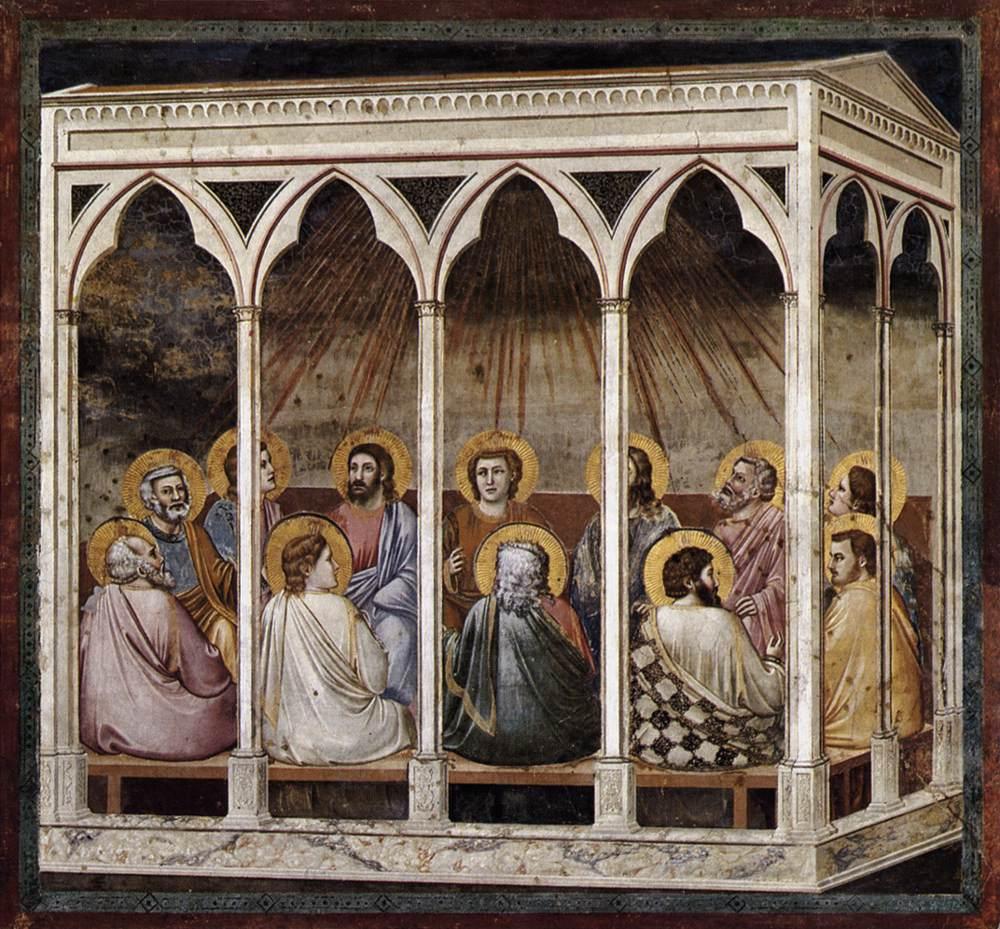
Picture: Giotto di Bondone – No. 39 Scenes from the Life of Christ – 23. Pentecost. Public Domain, Wikimedia Commons
It’s a provocative title, I know. Pentecost in the Christian tradition, celebrated on 8 June this year, commemorates the coming of the Holy Spirit upon the disciples as recorded in Acts 2. And in some Christian circles, the Spirit seems to get so little mention already that I wasn’t sure it was a good idea to write this. But at the same time, perhaps it might be a helpful reminder that in all God does, all of God is involved.
Key moments in God’s story can bring us to focus on one member of the Trinity. At creation, we often tend to see God the Father at work. At the Cross, our attention is usually on God the Son. And at Pentecost, naturally our focus is on God the Holy Spirit. But at creation, we see a probable mention of the Spirit of God (Gen 1:2), while all things are made through Jesus (John 1:2) and for Jesus (Col 1:16). At the Cross, Jesus prays to the Father, while we are told in Hebrews 9:13 that Jesus offered himself to God through the eternal Spirit.
So what about Pentecost? I want to think not about the event itself, but the promise which is realised in the event, the anticipation of the gift of the Spirit. In John 7, Jesus is in Jerusalem for the Festival of Tabernacles. He stands up and makes the promise of living water, a promise that extends to all who believe (John 7:38). We then get the explanation that Jesus was talking about the gift of the Spirit, which at that point in the story had not yet been given (7:39).
This is not the first time Jesus talks about living water in John‘s gospel. In John 4, when Jesus talks with the Samaritan woman, he talks about the gift of living water. There, Jesus does not elaborate on what he means. The woman doesn’t seem to understand – she just thinks of the practical benefits if she were never physically thirsty again. The dialogue presses on, though, and the idea of living water is left behind as an enigmatic symbol.
Yet there is an important connection that is made when Jesus raises the matter of living water. He begins by telling the woman that if she knew who he was, then she would ask for this living water. The gift of living water is tied to Jesus’ identity. There is something about who he is that means he can give this living water.
If we jump back to John 7, that then means that the gift of the Spirit is tied to the identity of Jesus. And we can see in the context of Jesus’ words about the gift of living water which is the Spirit, the focus is on who Jesus is.
To understand that further, it might be helpful to step back to think about when Jesus is speaking these words. Jesus is in Jerusalem for the Feast of Tabernacles – just as with Pentecost, God uses the calendar he created for his people as the backdrop for his action in the world. The Feast of Tabernacles is set out in the Law (Lev 23:33–36, 39–44; Deut 16:13–15). It celebrates Israel’s wandering in the desert, and references the tabernacles or shelters in which they lived as they travelled.
But there are other associations that build up over time with this festival. The first is that it is the occasion when the Temple of Solomon is dedicated (2 Chron 5:3). Which makes the Temple, already important as the dwelling place of God on earth, even more a focal point for the festival. Alongside this, the Festival of Tabernacles is picked up on in later prophetic writings, notably in Zechariah 9–14. There we see the promise of the day of the Lord – a feature of the prophets that was the anticipated time when God would act decisively in the world. That included the coming of the Messiah (Zech 9:9) and culminates in the restored celebration of the Feast of Tabernacles (Zech 14:16–19). Part of the promise of this day of the Lord was that living water would flow out from Jerusalem, a flow that would never stop (Zech 14:8).
At Pentecost, we more often read from Joel (another of the prophets), as Joel 2 is quoted in the Pentecost story in Acts 2. As with Zechariah 14, Joel 2 is about the day of the Lord. Where Zechariah promises living water, Joel promises the outpouring of the Spirit on all God’s people. These are two different angles on the one event of Pentecost.
If we scroll forward to Jesus’ time, water and the temple play an important part within the Feast of Tabernacles. On each day of this week-long festival, a large jug of water would be drawn from the spring just outside the walls of Jerusalem. It would be carried in procession up to the temple, where they would pour it out into a large funnel. This evoked Zechariah 14 and the connection that if you did not come up to Jerusalem to celebrate the festival, you would not receive rain.
These things are all in the background behind Jesus‘ words in John 7, they are all ideas that would have shaped how people would have heard what Jesus had to say. By picking up on such an obvious symbol from the festival, Jesus is saying that this festival points to him.
Let’s consider the layers of meaning here. At the first level, with the festival in its connections to the Exodus, Jesus presents himself as embodying a new Exodus. A new gathering of God’s people into the place of his promise. An end to wilderness wandering.
At the second level, Jesus links himself with the Temple, and the presence of God with his people. And for those reading this in the Gospel of John, we already have Jesus presenting himself as the Temple (John 2) as well as the representative of God who is “tabernacling with us” (John 1:14). While John 1:1 presents Jesus as God – something that those hearing Jesus on the occasion recorded in John 7 have yet to realise.
Then, thirdly, when we add in the resonances with Zechariah, Jesus is presenting himself as the one bringing the Day of the Lord – the Messiah. He is claiming to be fulfilling the promise of living water from Zechariah.
What does all of this add up to? The promise of the Spirit in John 7 is also a dramatic claim about who Jesus is. For Jesus to give the Spirit, for him to give living water, it means that Jesus is the Messiah, and he is God with us.
So while we rightly focus on the Spirit at Pentecost, we should do so in the context of a triune God who acts together in all things. It is in coming to Jesus that we receive the Spirit, and it is in giving the Spirit that Jesus demonstrates who he is, the Christ (Messiah) and the Son of God (John 20:31). May we glorify the God revealed as Father, Son and Spirit this Pentecost.
Dr Chris Seglenieks is a New Testament scholar with special interests in the Johannine literature and in the topic of faith. He currently works at Bible College SA as Academic Administrator, where he has taught New Testament and Greek. He has previously worked in several pastoral roles in Baptist churches in SA.

