
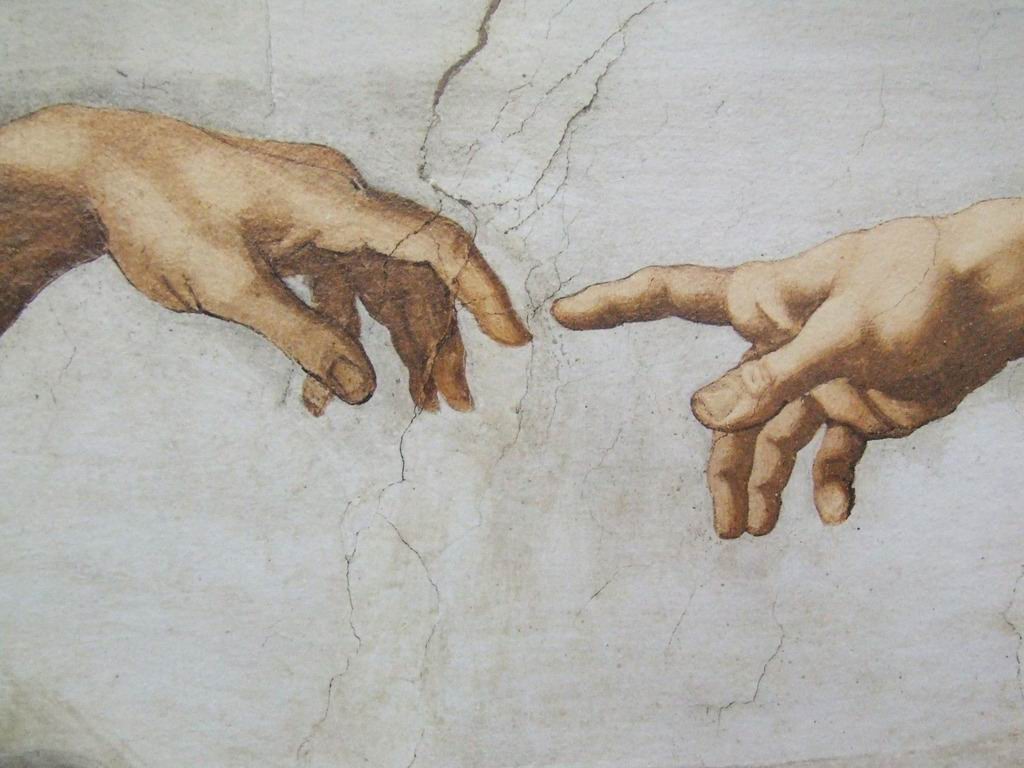
Picture by Michelangelo – Flickr: The Creation Michelangelo Vatican Museums Italy – Creative Commons by gnuckx, CC BY 2.0, https://commons.wikimedia.org/w/index.php?curid=22559081
“What do you do research in?”
“Christian disability theology.”
“Oh, what’s that?”
“It’s broad, but it looks at what disability has to do with the Christian God and how we think about God from the experience of disability, impairment, and diversity. I focus on theology, faith, and spirituality for neurodivergence and profound intellectual disability.”
Some raise an eyebrow, and ask questions like: “if God is perfect how can he be disabled?”, or “Oh so does that mean you’re redefining God in Man’s image?”, or “if someone has profound intellectual disability, can they believe in God?”
Others engage spiritually and share about how they have witnessed deep faith in loved ones with disability. Sometimes I hear sad stories about how a loved one and their family struggle to be a part of a Christian community, whilst other times I hear about how supportive Christian communities are.
In the last couple of years, I’ve heard disability theology mentioned with inverted commas (“disability theology”) as if to indicate a form of ‘specialness,’ in the same fashion of ‘special-education.’ There’s almost a suggestion from some that it sits on the outer and ranges between ‘suspicious theology’ to ‘liberal agenda.’
Can Theology Be Disabled?
Over the last few decades, considerations of embodiment, human limitedness, and relational Trinitarian theology, combined with increased disability advocacy, accessibility, and support, have raised awareness for disability within evangelicalism. My road towards disability theology began when my father took me, aged ten, to visit a lifelong friend with a degenerative disorder on my first trip back to Hong Kong. I was uncomfortable with her jerky movements, slurring of speech, and the lack of control. I wanted to look away and read outside. I pitied her. Yet, the conversation that she had with my father, the scant recollection I have of it, revealed to me her deep spirituality, care and love for others. I couldn’t reconcile within myself feelings of both pity and friendship.
Fast forward twelve years, questions bubbled to the surface when I started theological studies – what does sharing the gospel look like for a grandparent who has dementia? If they personally confessed their faith but have forgotten, are they saved? Are behaviours that deviate from the social norm of a Christian community necessarily sinful, like vocal outbursts or involuntary movements?
In a faith ecosystem where spiritual maturity and aptitude for leadership were being measured by intellectual assent and knowledge, how come my aunt with developmental delay would be the first to volunteer to pray? And why did kind and hospitable Christians ignore my friend with nonverbal autism and cerebral palsy at morning tea?
If I believe that God seeks to save all people in the world and God’s word has revelatory insight to this salvation for all people – how come some people are rarely considered as audience to God’s word and some experiences are rarely read alongside Scripture? Has theology, and the way scripture is read, been predominantly construed through able perspectives that tend to disregard the questions, life, and spirituality of human experiences that deviate from the norm? Is theology enabling faith or dis-abling faith?
Does Theology Disable?
In year four, my class was assigned buddies with the special education class and spent an hour every week with them. I remember creating some form of car with cardboard toilet rolls as wheels with Matthew (who was a year older than I), and found out that he caught the same bus home. So, most afternoons, we would catch the bus home together. I thought nothing of it until someone asked, “why do you hang out with him? He’s spastic [sic].” I didn’t know what the pejorative term meant, but I knew that he expressed things differently and so I realised this difference was meant to be a barrier. Over time, we drifted apart, but the lesson was learnt – there are some people with whom society doesn’t want to associate closely.
In her book Healing Ableism, Darla Schum defines ableism as
“at its most basic level… is discrimination against people with disabilities. Ableism also entails the assumption that able bodies – that is to say, bodies that function in ways that conform to social and cultural expectations of what is deemed ‘normal’ – are the presumed standard for which social, cultural, and built environments are constructed.” (p.6)
Carter’s review of seventy studies of disability inclusion in Christian communities between 1964 to 2019 showed little change in the 55 years in confidence with or understanding of how to support individuals and families” in Christian leaders (; there were few opportunities to serve at church, few actual roles filled, little training and discipleship, examples of explicit exclusion in a 2024 study by Carter and others showed that Christians with disability identified their church’s teachings as spiritually harmful.[1]
Disability theology asks if the call of salvation, the discipleship of God’s people, the edification of the church, the sending in mission, is for all? It is not an absence of people with disability in our communities that leads to their absence in our churches, 5.5 million Australians (21.4%) have disability and 7.9% have profound disability.[2]
This limited participation in the church suggests one or more theological limitations:
- a limitation of evangelical theological anthropology (this group of people might not be fully representative of being human);
- a limitation of theology (we don’t think about theology in light of this group of humans); a limitation of practice (we can’t imagine how to engage with a group of people);
- a limitation of hermeneutics (we can’t imagine what it is to be a person within this group);
- a limitation of relational absence (we can’t empathise or relate because we don’t know anyone with a disability);
- a limitation of meritocracy, exceptionalism, hyper-cognitivism, and logocentrism.
The questions I have raised in this article are the reasons why I research in disability theology, to contemplate how
“the Christian church has interpreted disability in its midst and has acted toward and with persons with disabilities;” whether it has been directly attributed to personal immorality, societal discrimination, the consequences of the fall, divine punishment, spiritual attack, otherness, or mysterious gifting, perspectives on disability “often uncovers uncertainties and confusions, contradictions and ironies.”[3]
More than that, perhaps every Christian is a disability theologian – for we all partake in the pilgrimage of knowing God in limited, vulnerable, and beloved bodies.
[1] Carter, 2023, p. 197, Carter et. al., 2024, p.212-213
[3] Eiseland, 1994, p.69.
Sam Wan is the Dean of Academics at Robert Menzies College, researches in disability theology, and is a board member of Jesus Club Ministries, a ministry that supports discipleship of adults with intellectual disabilities. He has bipolar, which has helped shape his approach to pastoral care, academia, and growing in the fruit of the Spirit.

